WHAT ARE THEY?
Accreditation is now open for members of the media planning to attend the 2026 Arctic Winter Games.
Click below to access the application form:Arctic Sports generally refers to a set of traditional games that, since time immemorial, have been part of life for Inuit peoples across a vast area stretching from Alaska to Greenland. These games were used not only to entertain, but to develop individual physical abilities—from balance and flexibility, to strength and pain tolerance—that were crucial for collective survival in a challenging natural environment.
Arctic Sports and Dene Games are the only Arctic Winter Games athletic events that include adult categories. This reflects the importance of positive mentorship within Indigenous cultures.
THE EVENTS
There are ten events in the Arctic Sports competition for the 2026 AWG. U17 athletes compete in six events, open females in seven events, and open males in 10 events. Athletes in each category also compete for gold, silver and bronze ulus for “All-Around” athlete.
The scoring for All-Around is based on a point system that awards points to the top ten competitors in each event, with 10 points going to the gold ulu winner and a single point to 10th place. U17 and Open Female athletes must compete in a minimum of four events to be eligible. Open Males must compete in at least six.
General Rules
- When the games are held in North America, all field-of-play measurements are in imperial (feet and/or inches).
- The order/rotation in which athletes compete is determined by random draw.
- Athletes are NOT permitted to use or wear braces, sports tape, massage guns, rollers or compression clothing during an event.
- Athletes may wear jewelry, headphones, ear buds and other wearable items between but not during attempts.
Height Events
Each competitor gets three (3) consecutive attempts at a height. Only successful kickers advance to the next height. The ball is initially raised in four-inch increments, dropping to two-inch increments when four competitors remain. The increment drops to one inch after the Arctic Winter Games record has been matched.
Each competitor has 90 seconds to complete an attempt (a single kick or reach). The time allotment rises to three minutes when there are only three competitors remaining. Officials indicate when there is one minute remaining in an attempt.
Ties are broken first by comparing the number of misses, then the earliest misses. If competitors remain tied (for medal positions only), there is a “kick-off” or “reach-off” starting at a height one-inch higher than the last height successfully attempted.
Alaskan High Kick
All categories Wednesday, Thursday & Friday
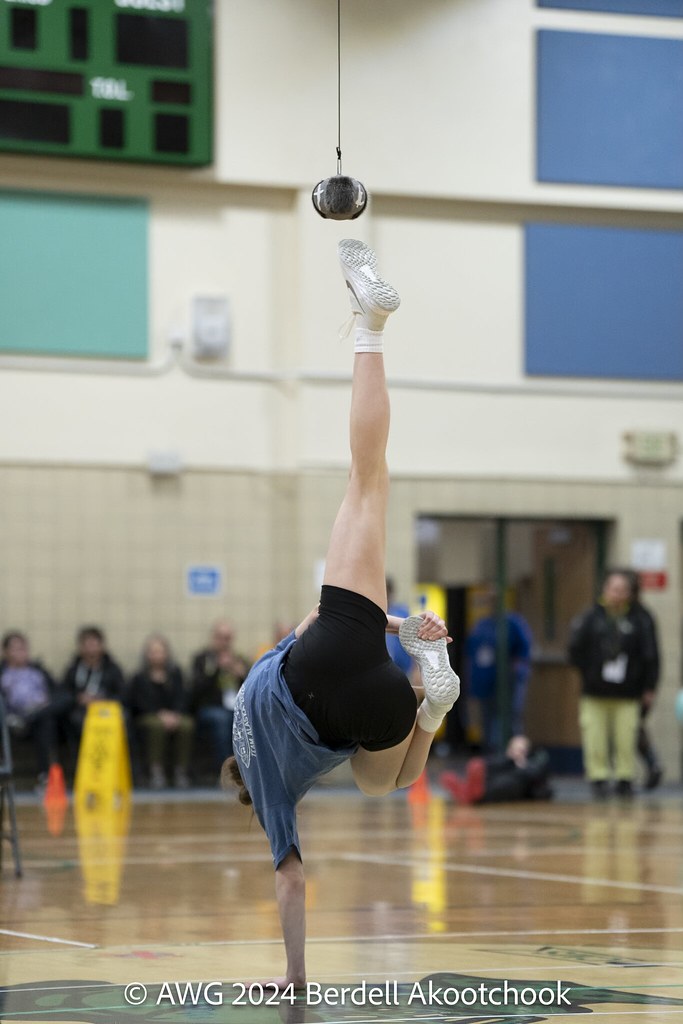
From a sitting position, the athlete uses one hand to grasp the opposite foot, while the other foot and hand remain on the floor. The athlete then thrusts the supporting foot off the floor to kick a suspended ball, such that the only part of the body that remains in contact with the floor is a single hand. The athlete must complete the kick with a controlled landing on the kicking foot.
Things to know or watch for:
- The athlete chooses the kicking foot. No alternation is required.
- The “foot” is considered any part of the foot below the ankle.
- The athlete’s supporting hand may be placed flat on the floor, bridged with fingers, or with knuckles in a fist.
- The athlete may not let go of the grasped foot at any time.
- The athlete is permitted to hop around while establishing the controlled landing.
- The athlete’s buttocks may not contact the floor in the landing.
- Some athletes may “go vertical”—but they may not do so in a sweeping or “cartwheeling” fashion, such that they land on the side of the target ball opposite from where they took off.
Traditionally, the Alaskan high kick was a game played in confined “interior” spaces during the winter. After dipping a toe into the remnants of a fire, competitors would perform a kick with the goal of marking the highest point with ash.
One-Foot-High Kick
All Categories
Wednesday/Thursday evenings & Friday afternoon
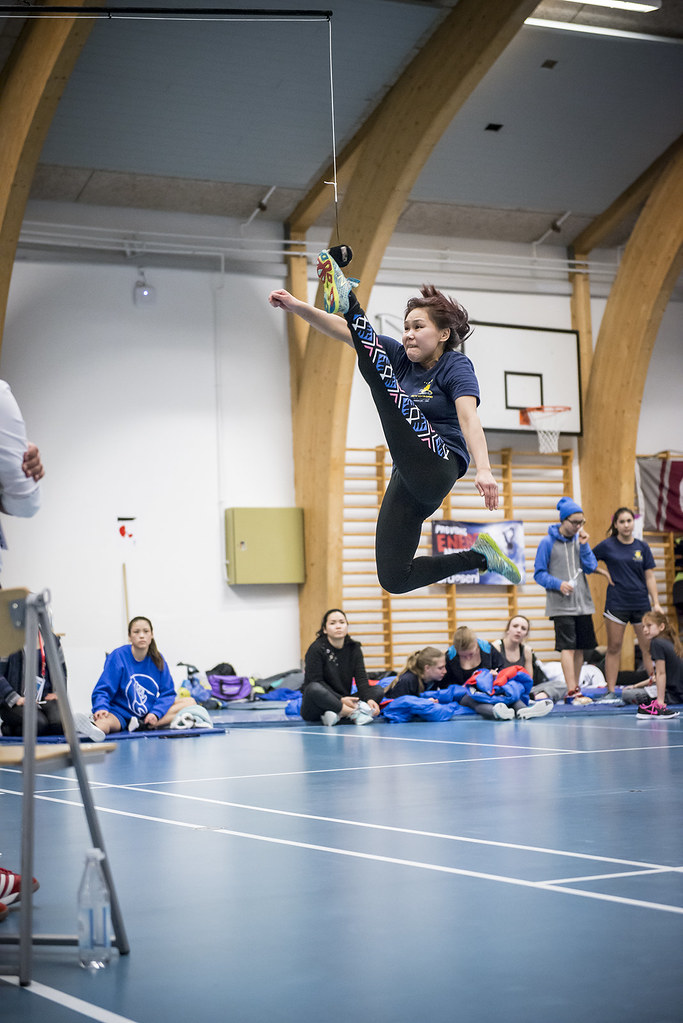
From a standing or running start, the athlete jumps with both feet, kicks a suspended ball with any part of one foot, then makes a controlled landing on the kicking foot alone.
Things to know or watch for:
- The “foot” is considered any part of the foot below the ankle.
- The athlete chooses the kicking foot. No alternation is required.
- It is not an attempt unless the athlete “breaks the knee.” The athlete may run up to the target and jump, but the legs must remain straight.
- The athlete is permitted to hop around while establishing the controlled landing.
- Officials on the field-of-play may see that the toe, or some other legal part of the foot, touches or brushes the target in a way that subtly affects its spin but may not be visible to an observer located further away.
Traditionally, the one-foot high kick developed as a form of communication across the flat tundra or ice. Following a successful hunt, a messenger would return towards the settlement or camp and, once within sight, do the one-foot high kick to signal that the hunt had been successful.
One-Hand Reach
Open Male, Open Female
Tuesday morning
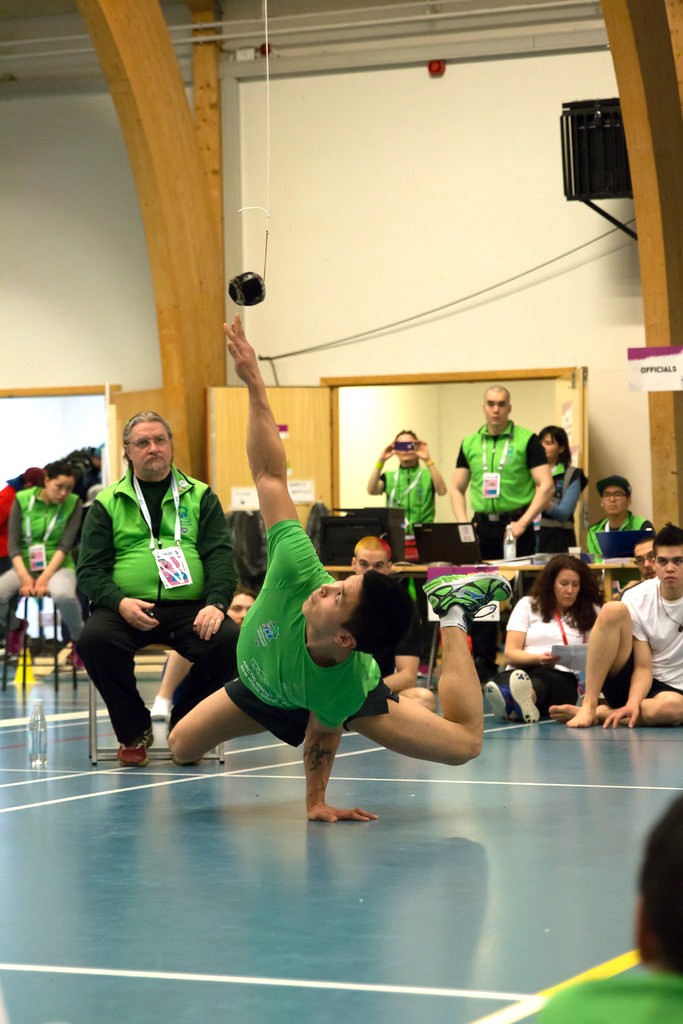
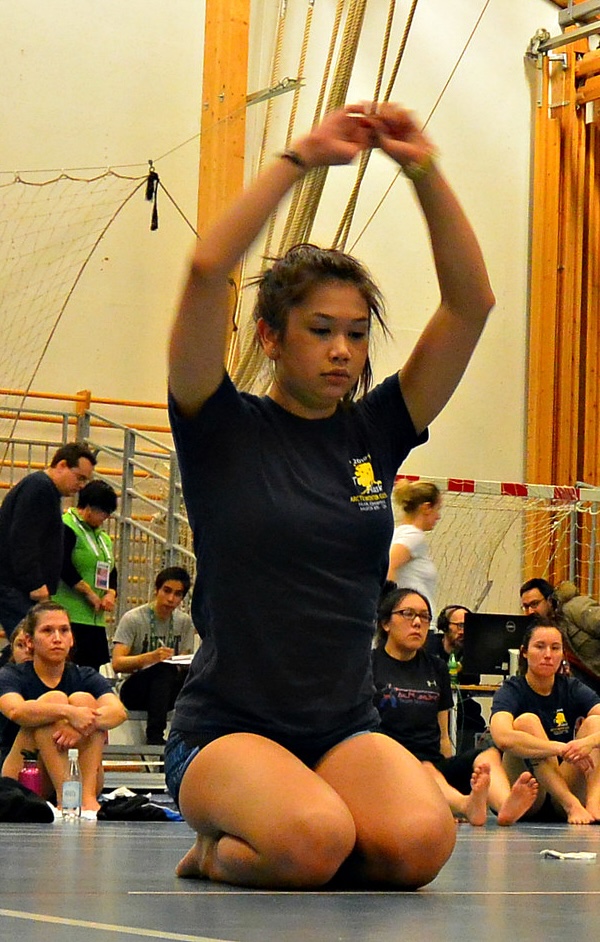
Initially using both arms to support and balance their entire body off the floor, with one elbow tucked into the body, the athlete lifts one hand off the floor and reaches to touch a suspended ball. The athlete must then return their reaching hand to the floor, re-establishing balance on both hands without any other part of their body contacting the floor.
Things to know or watch for:
- The athlete chooses the reaching hand. No alternation is required.
- The athlete’s supporting hand may be placed flat on the floor, bridged with fingers, or with knuckles in a fist.
- It is not an attempt unless the reaching/striking hand is lifted towards the target and crosses the elbow of the balancing arm, or the shoulder of the reaching arm is raised as if to reach.
- Some athletes have used a so-called “pike” (V-legged sitting) position.
- Officials on the field-of-play may see that the hand touches or brushes the target in a way that subtly affects its spin but may not be visible to an observer located further away.
Traditionally, the one-hand reach was played inside during the winter as a way to build and maintain strength, balance, agility and concentration.
Two-Foot-High Kick
All categories
Monday & Tuesday afternoons
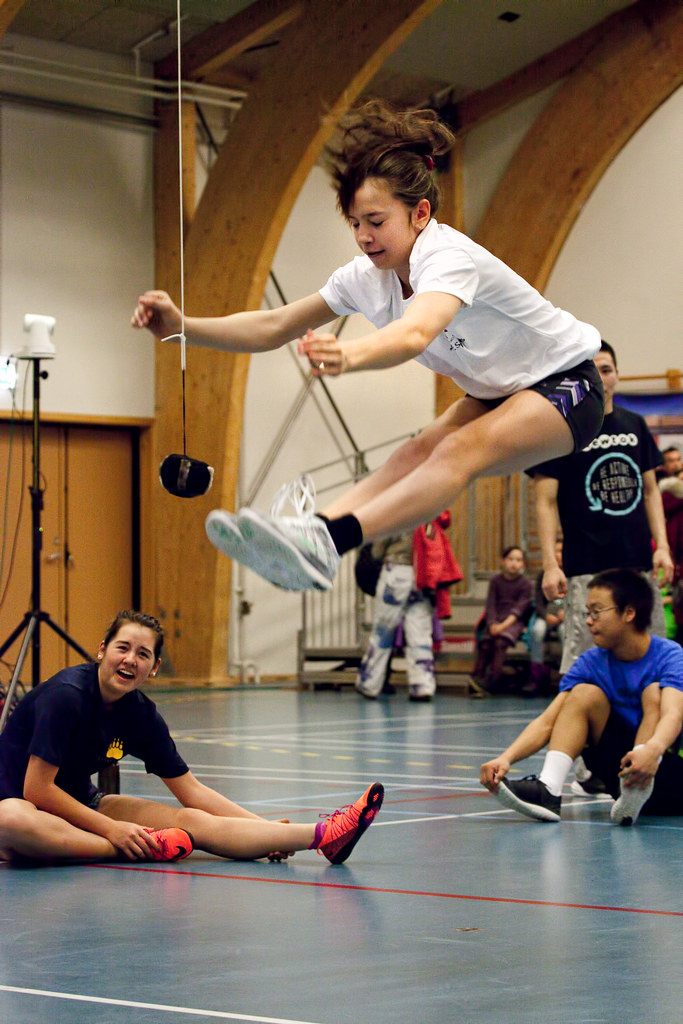
From a standing or running start, the athlete jumps with both feet, kicks a suspended ball with any part of one foot, then makes a controlled landing on both feet. While only one foot needs to contact the ball, the two feet (tops of toes) must be level with one another.
Things to know or watch for:
- The “foot” is considered any part of the foot below the ankle.
- The athlete chooses the kicking foot. No alternation is required.
- It is not an attempt unless the athlete “breaks the knee.” The athlete may run up to the target and jump, but the legs must remain straight.
- The feet may be parallel, in a V or an inverted V; they do not have to be touching one another.
- The athlete is allowed to hop around while establishing the controlled landing.
- Officials on the field-of-play may see that the toe, or some other legal part of the foot, touches or brushes the target in a way that subtly affects its spin but may not be visible to an observer located further away.
Similar to the one-foot high kick, the two-foot variation was traditionally used to signal a successful hunt out on the tundra or ice.
Distance & Timed Events
For kneel jump and triple jump, each competitor gets three (3) non-consecutive attempts. There is a time limit of 90 seconds per attempt. Ties are broken first by comparing second and third-longest jumps. If competitors remain tied (for medal positions only), there is a “jump-off.”
For airplane and knuckle hop, competitors are limited to a single attempt… for reasons that should be abundantly obvious. There is a time limit of 90 seconds to begin the attempt. There are no tie-breakers for any positions, including medal placements.
For all events, officials indicate when there is one minute remaining in an attempt.
Airplane
Open Male
Friday afternoon
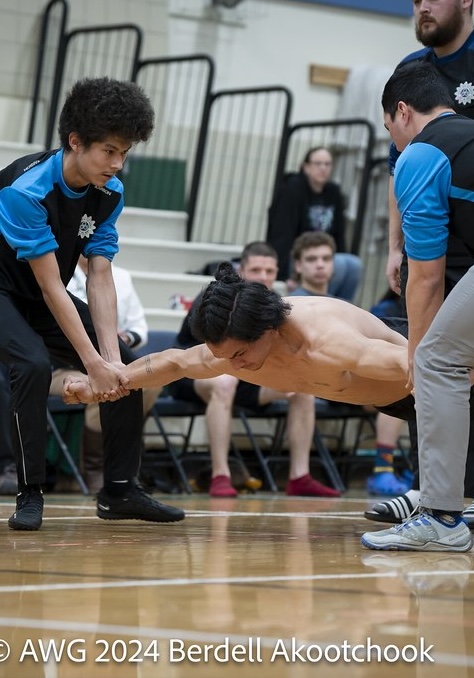
The athlete lies face down on the floor with his legs and feet together, arms outstretched at right angles to his legs. He must maintain this rigid position as four officials who act as “carriers” (two for the legs, one for each arm) lift his body several feet off the floor and “fly” him over a pre-set course at a steady pace. The carriers at the feet use a leather strap to lift the competitor. The winner is determined by the longest time “in flight.”
Things to know or watch for:
- Athletes are carried at a height of between two and three feet above the floor.
- The athlete’s arms must remain in a locked position with the torso not sinking below the level of the wrists.
- In the locked position, the angle between the shoulders, elbows and fists cannot exceed 45 degrees.
- The same carriers are used for each athlete, along with the same “pacer” to ensure the carriers maintain a consistent pace throughout each attempt and among competitors.
- The head official will stop the attempt if the athlete fails to maintain the requisite form.
Along with the knuckle hop, this may be the ultimate test of strength, endurance, resolve and pain tolerance in traditional Inuit games. There’s a reason it’s the final event in the Arctic sports competition schedule.
Kneel Jump
All categories
Tuesday, Thursday & Friday
The athlete assumes a kneeling position, such that the legs (from knees to toes) lie flat against the floor, with the knees aligned behind a start line. The athlete then jumps up and forward in a single motion, landing on both feet simultaneously—without moving the feet or touching the floor with any other part of the body.
Things to know or watch for:
- In preparation for a jump, the athlete may swing their arms, rock their body up and down, even lifting the knees.
- The athlete must make a natural, controlled landing and remain in that position—without their feet sliding, pivoting or otherwise moving—until they receive clearance from an official.
Traditionally, kneel jump was a game used to strengthen the leg muscles for jumping from ice floe to ice floe, getting quickly to one’s feet to escape animals, or lifting prey after a successful hunt.
Knuckle Hop
Open Male
Wednesday afternoon
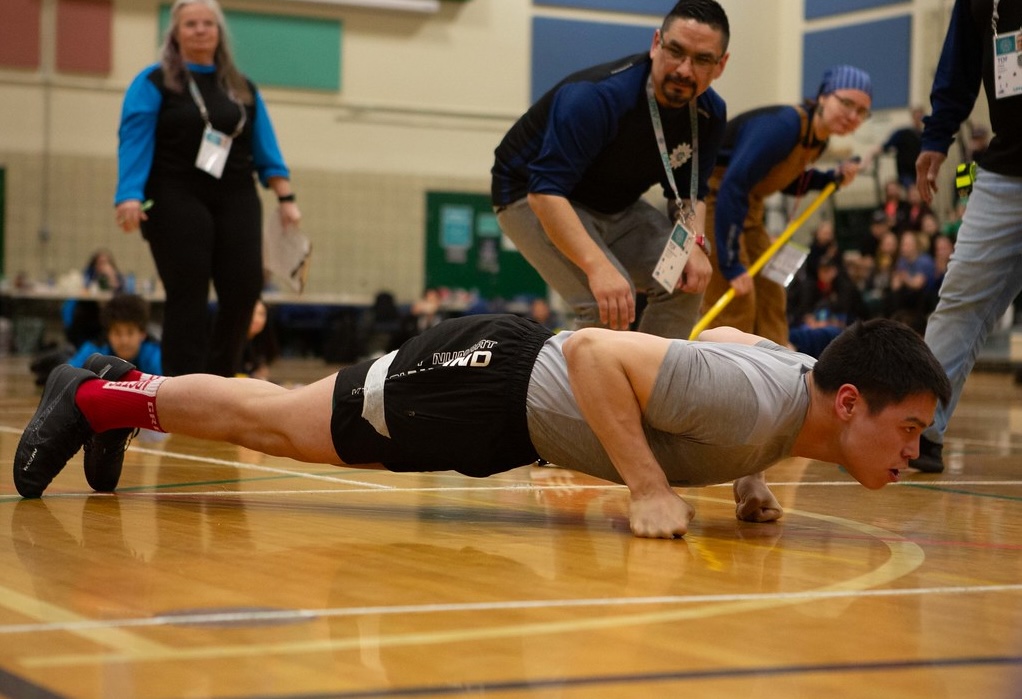
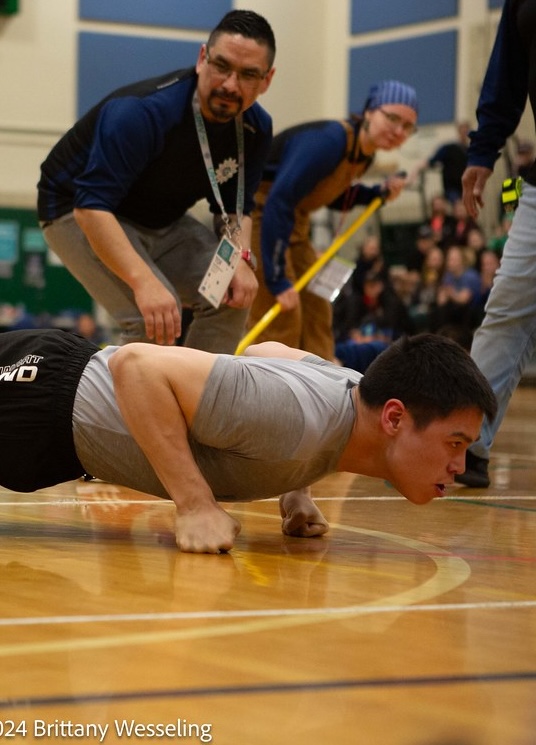
The athlete assumes the lower push-up position, with his bare-fisted knuckles against the floor. He then raises his body into the higher push-up position and uses his toes and fisted-hands to propel his body forward across the floor while maintaining a planked push-up position.
Things to know or watch for:
- The athlete’s shoulders are lined up with the start line.
- The athlete’s hands must be clenched into a fist, resting on the knuckles with thumbs placed over the top of the fingers. His arms and elbows must be tight to his body—not angled away.
- The athlete’s buttocks must not rise above the plane of his body as he propels himself forward using only his knuckles and toes.
- The head official will stop the attempt if the athlete fails to maintain the requisite form.
- The distance is measured from the start line to the position of the athlete’s shoulders when his attempt is complete.
Along with the airplane, this may be the ultimate test of strength, endurance, resolve and pain tolerance in traditional Inuit games. It appears to imitate the motion of a seal on the ice.
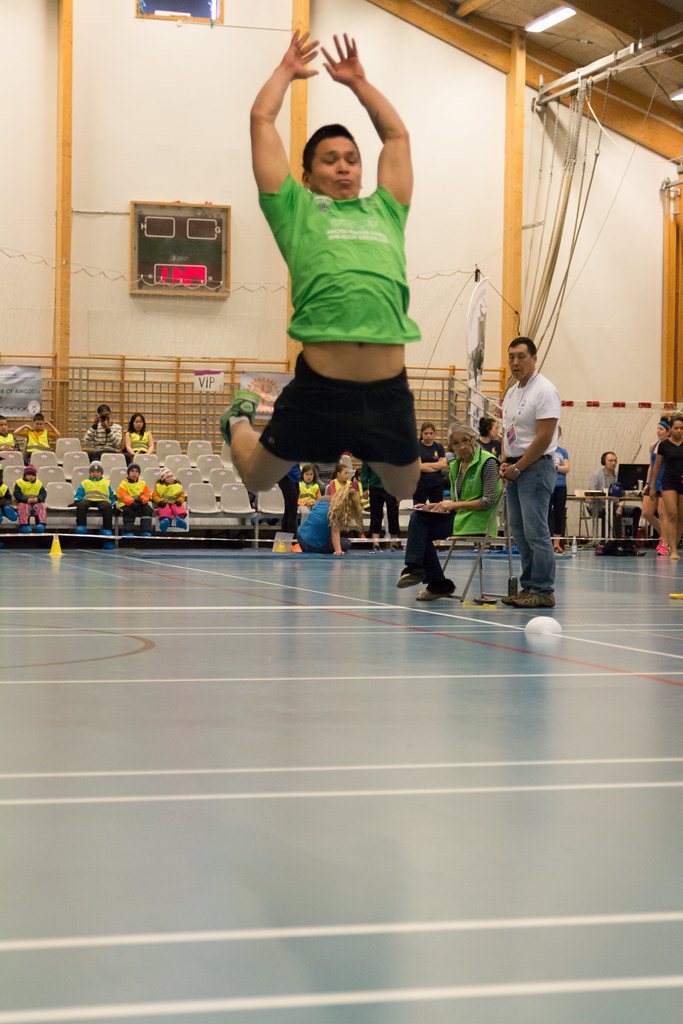
Triple Jump
All categories
Monday & Wednesday
From a running or standing start, the athlete takes off on both feet and makes three consecutive jumps, always landing and taking off on both feet in a single fluid motion—without pause. The athlete does not have to “stick” the final landing. The jump is measured from the point of body contact closest to the start line; if the competitor falls backwards, for example, the measure is taken from whatever body part is in contact with the floor closest to the line.
Things to know or watch for:
- An attempt can be disqualified for a number of reasons, including a foot fault at the start line, pausing, “galloping,” or failing to exit from the end of the jumping lane.
- Only jumps that are properly executed are measured.
- A raised flag indicates a failed attempt.
Similar to the scissor broad jump, the triple jump is a traditional discipline used by hunters and travelers to practice the skills needed to avoid water while moving across the tundra or shifting ice.
Match Events
Match brackets are determined by random draw. Competition is “double elimination,” such that a competitor must lose two matches before he or she is eliminated from the tournament.
There are no weight classes.
Arm Pull
Open Female, U17 Male and U17 Female
Thursday afternoon
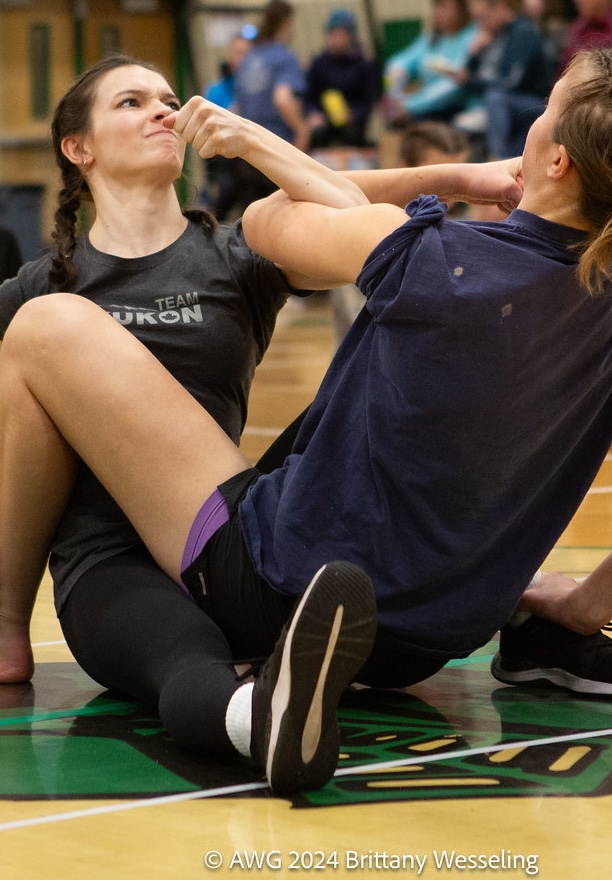
Sitting face-to-face on the floor, two opposing athletes interlock their legs such that each has one leg outstretched and the other bent with the foot flat on the floor. Next, the opponents take the arms corresponding to their bent legs and lock them at the elbow, while the hand of the unlocked arm holds the ankle of the opponent’s bent leg. Each athlete then tries to pull straight and steadily back, without twisting, until their opponent is pulled on top of them, has their arm pulled straight, or touches their chest with their hand. Each match is best-of-three.
Things to know or watch for:
- Arms are alternated for the first two pulls. If a tie-breaking pull is required, the winner of a coin toss chooses the arm.
- Competitors must be in short sleeves and remove watches, bracelets, bands or anything else that might interfere with a pull.
- Competitors may not grab their opponent’s arm during the initial locking. If the opponents fail to assume the correct starting position after two attempts, the officials will do it for them.
- Contact between the knee and elbow is not allowed.
- Officials may issue an athlete three warnings for various infractions (pulling too soon, jerking, twisting etc) before the pull is awarded to their opponent.
- If a competitor falls sideways, regrips with the pulling arm, or releases their grip on their opponent’s foot, they lose the pull.
- The officials may call for a re-pull, with the same arm, if there is a failed pull with no clear winner.
Traditionally, the arm pull was another game that helped hunters to develop strength, endurance and pain tolerance. It could be played over multiple days to determine the strongest person in the village.
Head Pull
Open Male
Monday evening
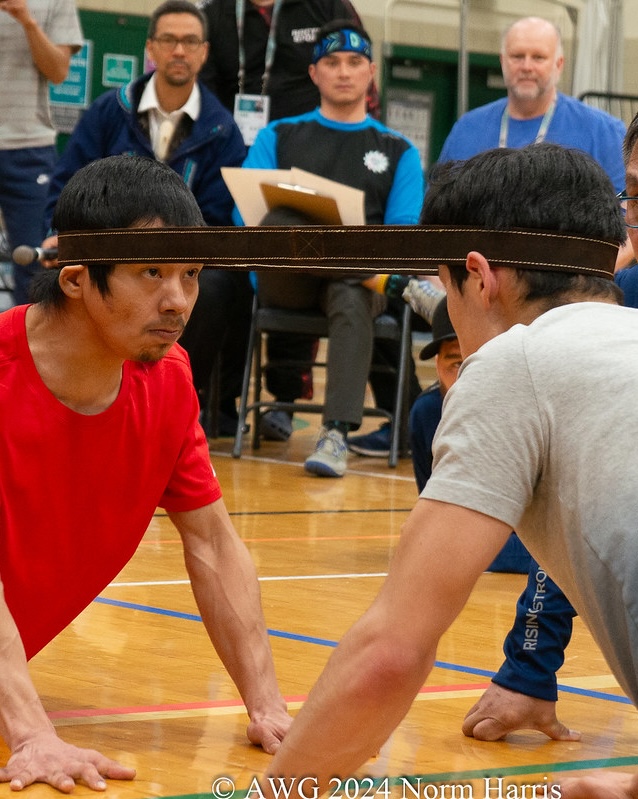
Lying face-to-face with their stomachs on the floor and heads equidistant from a dividing line at a right angle to the direction of their bodies, two opposing athletes have a looped leather belt placed around the backs of their heads above the ears. Next, they rise to a position where only their hands, feet and knees touch the floor. Finally, each athlete tries to pull his opponent forward so that his hands are two feet beyond the dividing line, or so that the opponent’s head drops and releases the belt. There is a single pull for each match.
Things to know or watch for:
- The looped leather belt is approximately three (3) feet long and 1.5 inches wide.
- The pull must be directly back and parallel to the ground.
- Incidental contact between the floor and the knees or thighs in acceptable.
Traditionally, head pull was another activity that could be done in confined spaces to build crucial strength and pain tolerance. It appears to mimic a fight between two walruses…
Resources
Northwestel
Northern Vision Development (NVD)
Gold Sponsors
Yukon Energy
Dakwakada Capital Investments (Northerm Windows, Castle Rock)
Mammoth Agency
Air North, Yukon’s Airline
Funding Partners
Legacy Partner
Gold Sponsors
Silver Sponsors
Bronze Sponsors
Games Suppliers
Games Supporters
Friends of the Games
Remarque :
La traduction française du site est générée automatiquement et peut ne pas être totalement exacte.
please note :
French translation on the site is auto generated and may not be fully accurate.
Should there be an issue with the translation, please email info@awg2026.org